
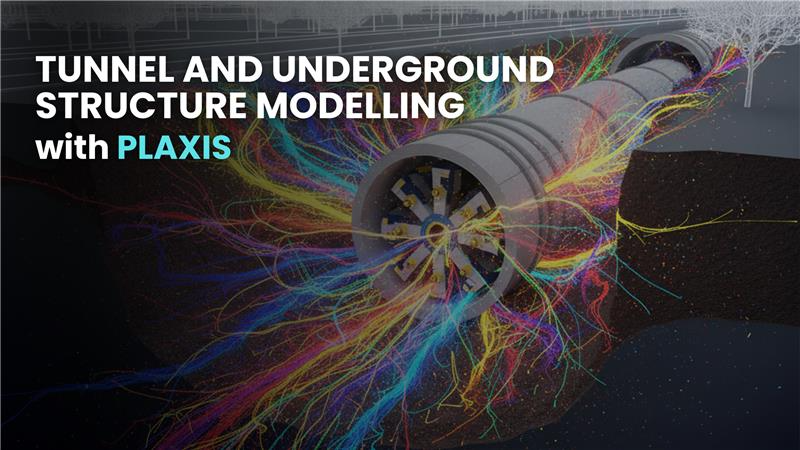
Do you know about the most technically challenging projects in civil engineering? These are tunnels & underground infrastructure projects. From metro tunnels to utility passages & deep basements are all examples of underground infrastructure. And these structures demand precise analysis of soil structure interaction, groundwater conditions & excavation-induced stress.
In this scenario, PLAXIS software has emerged as an industry-standard tool. It enables engineers to simulate complex geotechnical scenarios with high accuracy. For the professionals & students who want to upgrade their skills, there is no better option than PLAXIS.
Why Use PLAXIS for Tunnel & Underground Modelling
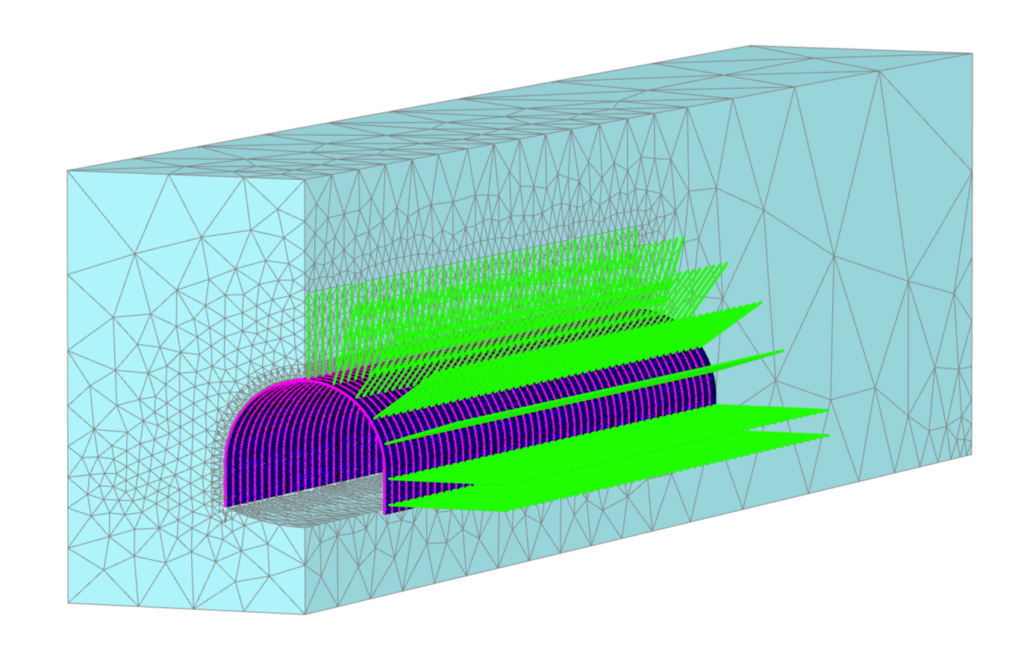
PLAXIS is a software tool. It works on the principle of the finite element method. And it is developed specifically for geotechnical analysis. Its powerful simulation capabilities allow engineers to model soil behaviour, tunnel lining stresses, support systems & staged excavation sequences.
By recreating real-world conditions, PLAXIS helps reduce design uncertainties, optimize construction methods & prevent costly failures. With the rising demand for underground infrastructure globally, mastering PLAXIS is a necessity. This condition leads to the growth of online PLAXIS software training. It provides flexible access to learning modules for engineers worldwide.
PLAXIS 2D: Reliable Analysis for Uniform Structures

PLAXIS 2D specializes in two-dimensional modeling of tunnels, embankments, & retaining walls. Its features include realistic soil behavior modeling, precise load and boundary condition application, & the ability to assess settlements, deformations, & groundwater effects. This makes it ideal for projects with uniform geometry & provides a clear understanding of soil-structure interaction.
PLAXIS 3D: Tackling Complex Geometries
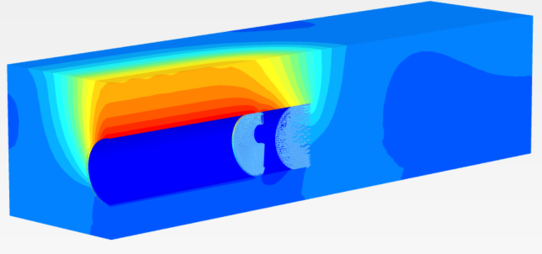
PLAXIS 3D extends analysis to complex underground structures with irregular shapes, intersecting shafts, or layered soils. It captures 3D stress distributions, structural interactions, & staged construction impacts. It enables engineers to evaluate potential risk zones and optimize designs for safety and efficiency.
Advantages of the PLAXIS Software Training Online
One of the biggest benefits of PLAXIS Software Training Online is the flexibility. Engineers can learn at their own pace, revisit the modules for the complex concepts, & apply them to practical case studies.
Also, PLAXIS learning provides insights into industry best practices. And it includes:
- Design optimization for tunnel linings.
- Risk assessment of excavation-induced settlements.
- Cost-effective construction planning.
- Accurate prediction of soil & structural behavior under loads.
Conclusion
With the rise of urbanization & underground infrastructure development, expertise in tunnel & underground structure is in high demand. And enrolling in the PLAXIS course, whether it may be a PLAXIS 2D/3D training course. It prepares engineers with the tools to tackle complex projects confidently. With the PLAXIS Software training course online, engineers gain practical knowledge, enhance their career prospects & contribute to the safer, more efficient underground construction.
In essence, the PLAXIS training & PLAXIS learning are not just educational options. But they are strategic investments for any geotechnical or civil engineers who aim to stay ahead in modern infrastructure development.
Contact us today to get started!