
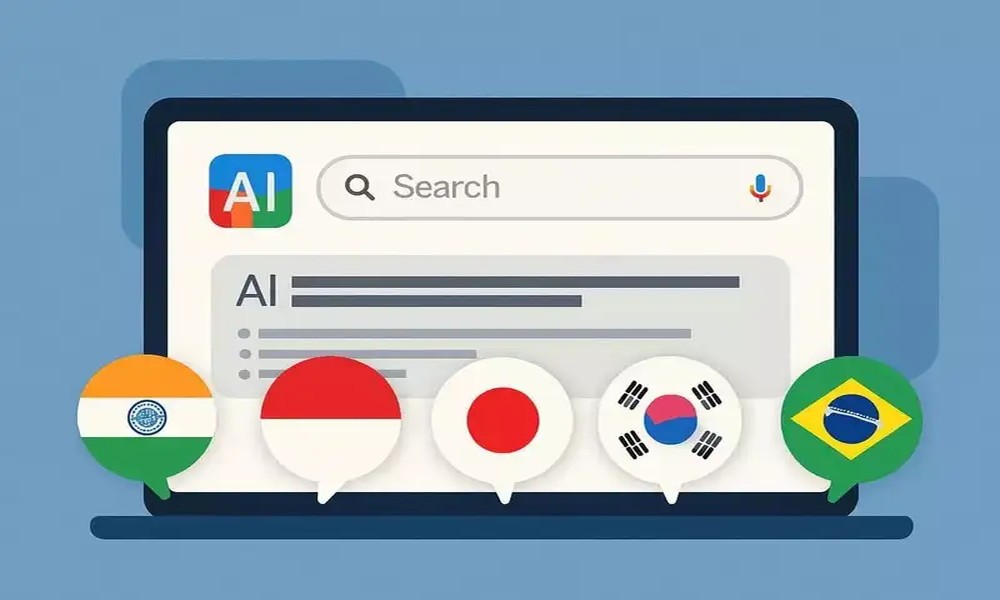
When Google announced that its AI Mode would expand to cover more languages, including Hindi, Korean, Japanese, Indonesian, and Brazilian Portuguese, the move was more than a technical update. The update became a milestone, giving people worldwide the ability to explore the internet in familiar languages with replies fine-tuned to their surroundings. For too long, English has dominated the digital experience; Google’s multilingual AI Mode is beginning to change that balance.
Google’s Push For Inclusive AI
Google has long positioned itself as the company that organises the world’s information. With the rollout of AI Mode across multiple languages, it is also working to democratise how that information is consumed. For users in India, for example, the ability to ask a query in Hindi and receive a conversational, context-rich response is transformative. The same applies in South Korea, where audiences increasingly expect answers in their native tongue rather than default English.
This shift highlights a new chapter in Google’s mission: ensuring that artificial intelligence is not just powerful, but also inclusive. By bringing AI-driven insights to a broader linguistic base, Google is effectively opening its platforms to communities that previously had to adapt to English-centric systems.
More Than Just Translation
One of the striking features of Google’s multilingual AI Mode is that it goes far beyond word-for-word translation. The system integrates cultural context, idiomatic expressions, and local references to ensure relevance. Asking for travel advice in Hindi produces responses framed around Indian destinations, while the same query in Korean surfaces suggestions grounded in Korean culture and geography.
This context-aware design is crucial. Traditional translation tools often miss nuance, leading to awkward or misleading results. Google’s approach combines its vast search infrastructure with natural language understanding, giving users not only answers but answers that “make sense” in their world.
Tackling The Complexities Of Speech And Script
Handling multiple languages is not simply a matter of adding dictionaries. Google faces the challenge of script diversity, accent recognition, and code-switching-the practice of blending languages in one sentence. In India, Hinglish (a mix of Hindi and English) dominates everyday speech; in Korea, users may combine Romanised and Hangul text.
Google’s experience with Android keyboards, YouTube captions, and Maps navigation has given it an edge here. Its multilingual AI Mode incorporates automatic speech recognition, transliteration across scripts, and refined pronunciation in text-to-speech. These details may sound technical, but they directly influence whether a grandmother in Lucknow feels understood or a teenager in Seoul finds the reply natural.
The Business And Learning Angle
For small businesses, the implications are enormous. A local entrepreneur can now reach wider audiences without worrying about language barriers. Customers can interact with search, shopping, and support content in the language of their choice, reducing friction and building trust. For global companies, multilingual support means fewer silos and more consistent customer engagement across regions.
For individuals, particularly in tech-driven cities, this development reinforces the value of acquiring AI skills. Understanding how multilingual AI works-how prompts are structured, how context is parsed, and how results vary across languages-has become an essential capability. Many learners are already pursuing structured pathways, such as an artificial intelligence course in Hyderabad, to gain practical expertise and align themselves with the global demand for AI fluency.
Challenges Of Scale And Trust
Expanding AI Mode into multiple languages also brings challenges. Bias is one concern; if the training data overrepresents certain dialects, responses can inadvertently privilege one community over another. Safety is another; content filters must be equally robust in Hindi or Korean as they are in English. Finally, transparency matters: users need to know when an answer is generated, what sources it relies on, and where limitations exist.
The company has improved its audit processes and welcomed feedback from diverse communities, but ensuring fairness while expanding globally is still a complex undertaking.
Designing For Everyday Realities
Global accessibility is not only about languages; it’s about infrastructure. Many users in India, Indonesia, or Brazil access the internet on budget smartphones with limited connectivity. Google’s AI Mode has to remain lightweight, offering reliable responses without draining data or battery. Offline caching, streamlined interfaces, and optimised performance are all essential if multilingual AI is to serve people beyond urban centres.
The company’s track record in building for constrained environments, such as Android Go and YouTube Lite, shows that it recognises this challenge. Extending that mindset into AI Mode ensures that inclusion is not just theoretical, but practical.
Measuring Success Beyond Numbers
It is tempting to measure success by the number of languages supported. Yet, the true metric is whether users feel empowered. Do they complete tasks faster? Do they understand explanations more clearly? Are answers as accurate in Hindi as in English? Google must continually track these indicators to ensure that expansion is meaningful rather than superficial.
Equity across regions is particularly important. An inconsistent experience risks reinforcing the very divides that multilingual AI aims to bridge. Closing these gaps requires constant fine-tuning and active collaboration with local speakers and experts.
Preparing For The Next Decade
Multilingual AI is not an endpoint but the beginning of a larger transformation. Future iterations could integrate richer cultural context, deeper personalisation, and even regional dialects within each language. Imagine an AI that not only understands Hindi but adapts to the differences between Lucknowi, Mumbai, and Delhi speech patterns.
For workers and learners, the next decade will demand adaptability. Understanding how to design, evaluate, and ethically deploy AI tools will be as important as technical skills themselves. In cities like Hyderabad, where technology ecosystems are thriving, opportunities such as an artificial intelligence course in Hyderabad provide a bridge between curiosity and competence.
Conclusion
From Hindi to Korean, Google’s multilingual AI Mode signals a shift towards digital inclusivity. It breaks down barriers for small businesses, empowers individuals to seek knowledge in their own language, and strengthens cultural identity in the digital sphere. The impact may begin with search queries, but it extends far beyond-reshaping how billions engage with technology daily.
The real promise of Google’s multilingual AI Mode lies not in the number of languages it supports, but in how effectively it delivers relevance, respect, and reliability to each user. As AI becomes a universal interface, ensuring that it speaks everyone’s language-literally and figuratively-will define its role in building a more connected, equitable world.